
Designing the Modern Dental Lab: A Blueprint for Efficiency, Craft, and Digital Precision
Setting up a dental laboratory is a delicate balancing act between honoring time-tested craftsmanship and embracing the rapid pace of digital innovation. Whether you are launching a boutique studio or a high-volume production center, your floor plan dictates your daily stress levels and your final product quality.
In this guide, we break down the essential layout departments and equipment planning required to build a lab that flows as smoothly as a well-poured impression.
The Philosophy of Layout: “Clean” vs. “Dirty”
A successful dental lab design separates “wet/dirty” zones from “dry/clean” zones to protect sensitive equipment and ensure technician health. Your layout should follow a logical path: from the Stone Room for model work, moving through the Digital CAD/CAM or Wax Station, and ending in the Casting or Milling Room for final fabrication.
- The Stone Room: The Foundation
The Stone Room is your heaviest “wet” zone. It must be physically separated to keep gypsum dust away from scanners and milling spindles.
- Key Equipment: Model trimmers, vacuum mixers, and vibrator tables.
- Pro Tip: Invest in high-quality plaster traps for your sinks to avoid costly plumbing disasters.
- The Casting Room: The Heart of the Craft
For labs utilizing the traditional lost-wax technique, the Casting Room is the engine room. This area handles high heat, fumes, and significant dust.
Necessary Additions: Beyond the burnout oven and casting machine, this room should house your Polishing Lathe and Air Pressure Polymerization Unit.
Design Note: Since this room generates heat and chemical vapors, a dedicated, high-volume ventilation system is non-negotiable.
- The Digital Hub: CAD/CAM & Milling
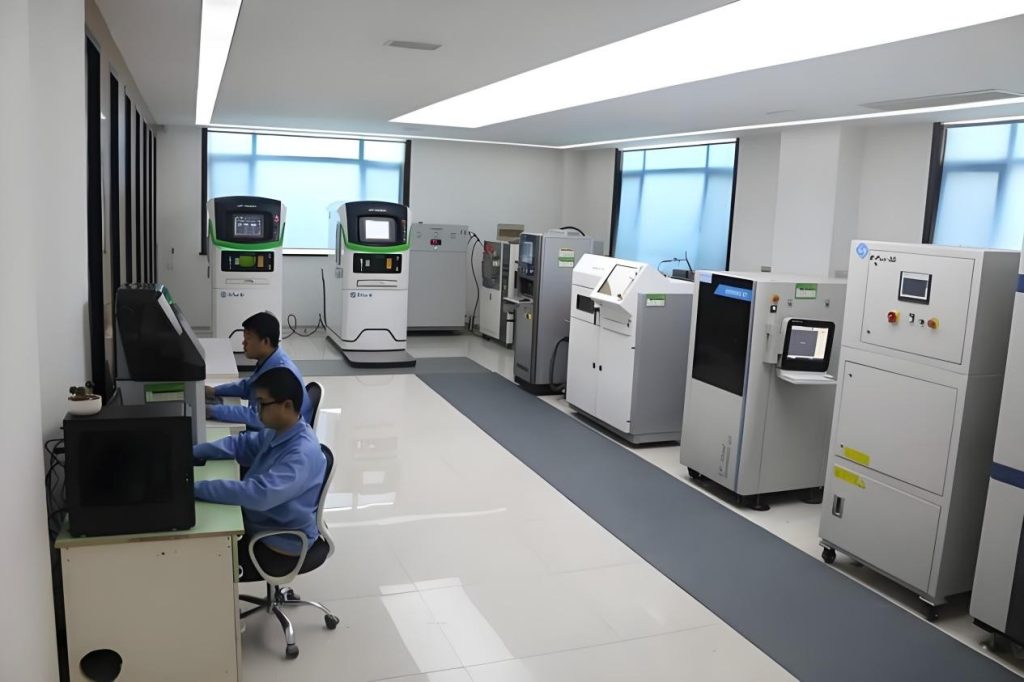
The Milling Room and CAD/CAM Station represent the “dry/clean” precision zone. This area houses your most expensive electronic assets, which must be kept in a climate-controlled, dust-free environment.
Milling Room: Contains dry or wet milling machines and sintering furnaces.
CAD/CAM Station: High-performance design PCs and desktop scanners.
Fabrication Choice: Milling vs. Manual Lost-Wax
Modern labs often debate between digital milling and the manual lost-wax craft. Most successful labs today use a hybrid approach.
Milling: Ideal for Zirconia, PMMA, and high-strength ceramics. It offers speed, repeatability, and reduced material waste.
Manual Waxing/Casting: Still essential for intricate partial frameworks (RPDs) and certain high-noble alloys that require a “human touch.”
Essential Equipment & Budget Planning
When planning your purchase, prioritize equipment that reduces labor-intensive steps. Below is a compact guide for outfitting your departments.
| Department | Primary Function | Essential Equipment |
| Stone Room | Model Prep | Model Trimmer, Vacuum Mixer, Vibrator, Die Stone. |
| Casting Room | Metal/Resin | Burnout Oven, Casting Machine, Polishing Lathe, Pressure Unit. |
| Milling Room | Digital Fab | 5-Axis Milling Machine, Sintering Furnace, 3D Printer. |
| CAD/CAM Station | Design | Desktop Scanner, Design Software (CAD), PC. |
| Work Station | Finishing | Bench with Suction, Micromotor, Articulator, Electric Waxer. |
| Ceramic Station | Esthetics | Porcelain Furnace, Specialized Lighting, Ceramic Kits. |
Transitioning from traditional casting methods to a fully integrated digital workflow requires a strategic approach to equipment selection that balances precision with productivity. For technicians navigating this evolution, Dentsma serves as an invaluable reference, offering a curated series of dental lab equipments designed to bridge the gap between classic artistry and modern automation. Starting in the Casting Room, high-performance induction casting machines and pressure polymerization units ensure structural integrity and bubble-free results for frameworks and acrylics. As the workflow moves into the Digital CAD/CAM phase, the focus shifts to high-resolution scanners and 5-axis milling units that translate manual designs into precise physical restorations with micron-level accuracy. By integrating these systems, labs can maintain the tactile nuances of traditional wax-lost craft while leveraging the speed and repeatability of digital fabrication, ultimately elevating the standard of prosthetic care.
Optimizing the Work Station Area
The Work Station Area is where technicians spend 80% of their day. Ergonomics here is a direct investment in productivity.
Integrated Suction: Every station should have an individual dust collector.
Specialized Stations: Designate specific areas for Waxing (WAA) and Ceramics to prevent cross-contamination of materials.
Lighting: Use color-corrected “Daylight” LED lighting (approx. 5500K) to ensure accurate shade matching for crowns and bridges.
Final Thoughts for New Lab Owners
When looking at your “Proposed Dental Lab Entrance,” think of the workflow as a circle. Cases come in, get digitized or poured, move through fabrication, and return to the work station for final QC before shipping.
Budget Tip: If funds are tight, invest heavily in a high-end Scanner and Design Software first. You can always outsource your milling initially and bring it in-house (along with a milling machine) as your volume grows.
Designing a lab is about creating a space where technology and artistry can coexist without interfering with one another. By following a departmentalized layout, you ensure a cleaner environment, longer-lasting equipment, and a much happier team.